
Why Standing Out Matters More Than Ever for Graduates
Your undergraduate degree might not be enough anymore.
May 29, 2026
by Roisin Greenan
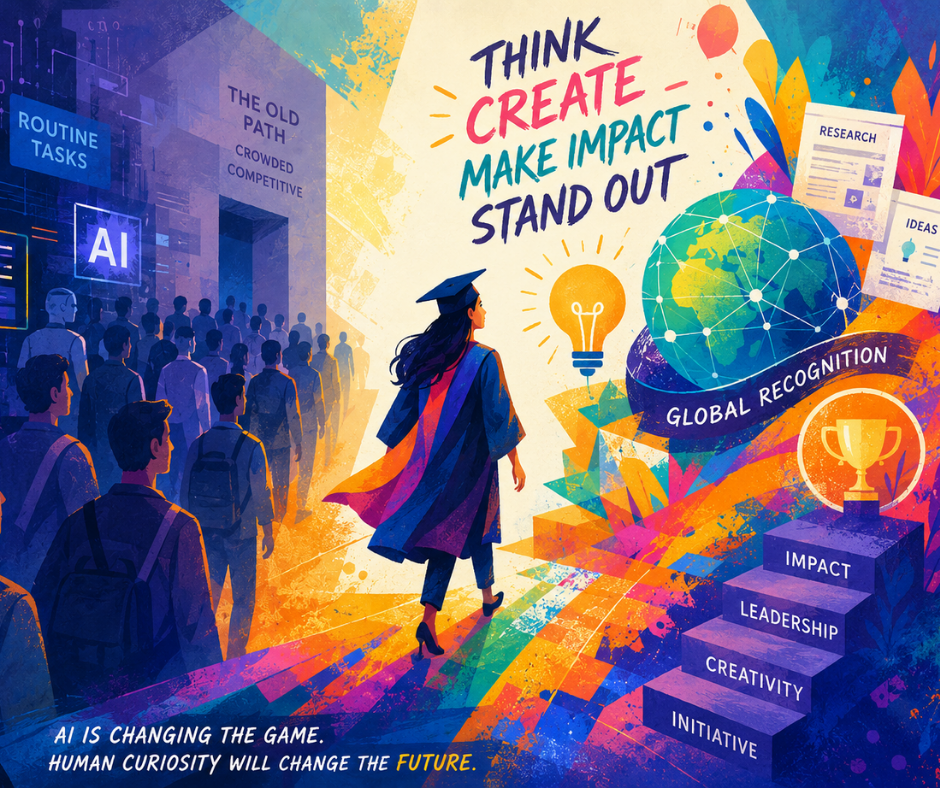
A recent article in Forbes explored a reality many students and recent graduates are beginning to feel firsthand: the graduate job market is changing rapidly under the pressure of artificial intelligence. Entry-level roles that once acted as stepping stones into professional life are shrinking, evolving, or demanding far more from candidates at an earlier stage.
For decades, graduates could reasonably expect that their degree alone would open doors. Today, employers are increasingly looking for something beyond academic completion. They are looking for evidence of initiative, originality, communication skills, leadership potential, adaptability, and the ability to apply knowledge in meaningful ways.
The challenge facing students is not simply competing against other graduates anymore. In many industries, they are also competing against automation itself.
Recent reporting from Forbes, Business Insider, and other workforce analysts points to the same trend: routine tasks traditionally assigned to junior employees are increasingly being handled by AI systems. Employers are consequently placing greater value on graduates who can demonstrate judgment, creativity, interdisciplinary thinking, and the ability to contribute beyond administrative or repetitive work – One line referenced in broader discussions around this issue captures the shift clearly: “What used to be ‘junior’ is now done by a tool.”
That changes the question students must ask themselves.
Not “Do I have a degree?”
But instead:
“What evidence can I provide that I can think, contribute, communicate, and create value?”
This is precisely where opportunities like The Global Undergraduate Awards become increasingly important.
The modern graduate marketplace rewards distinction. Employers, postgraduate programmes, scholarship committees, and research institutions are overwhelmed with applicants who often possess similar qualifications on paper. External recognition becomes a powerful differentiator.
Participation allows students to demonstrate far more than grades alone. It signals that a student was willing to take their work beyond the classroom, subject it to international evaluation, and compete within a global academic community…and that matters.
In a market where employers increasingly seek proof of initiative and independent thinking, submitting work to an international awards programme demonstrates ambition, resilience, and confidence in one’s ideas. Even the process itself communicates valuable traits: discipline, intellectual curiosity, and a willingness to engage with a wider academic audience.
The Forbes article highlights that graduates must now become “specific, strategic, and flexible” in how they position themselves professionally. The Global Undergraduate Awards helps students do exactly that by giving them a platform to articulate their research, sharpen their communication, and gain recognition outside their home institution, and, importantly, the value extends beyond winning.
The question students must ask themselves now is not, do I have a degree? But instead, what evidence can I provide that I can think, contribute, communicate, and create value?
Students who engage with the Awards often discover something larger: that their ideas have relevance beyond a classroom assignment. In an era increasingly shaped by AI-generated outputs and automation, original human insight becomes more valuable, not less.
Research, critical analysis, creativity, ethical reasoning and the ability to connect ideas across disciplines remain deeply human strengths. Those are precisely the qualities celebrated by The Global Undergraduate Awards.
The wider employment landscape reinforces this point. Studies examining AI-era workforce trends consistently show that soft skills and higher-order thinking are becoming more essential alongside technical literacy, The Times. Employers are increasingly prioritising communication, judgment, adaptability, and problem-solving abilities that cannot easily be replicated by automated systems.
Recognition programmes therefore become more than résumé additions. They become evidence of capability.
For many students, university can sometimes feel transactional – you complete assignments, earn grades and move on. But the students who increasingly stand out are those who transform coursework into something larger – published research, presentations, entrepreneurial ideas, competitions, leadership experiences, or globally recognised submissions.
The graduate who succeeds in the coming decade may not necessarily be the one with the highest marks alone. It may be the student who can demonstrate initiative, originality and the courage to put their work into the world.
As AI reshapes the foundations of entry-level employment, students must think differently about how they distinguish themselves. Visibility matters. Recognition matters. Evidence of impact matters.
And perhaps most importantly, the ability to show that behind the degree is a person capable of independent thought, creativity, and contribution matters more than ever.
