
GUA Alumni: Dr Fiona Malone
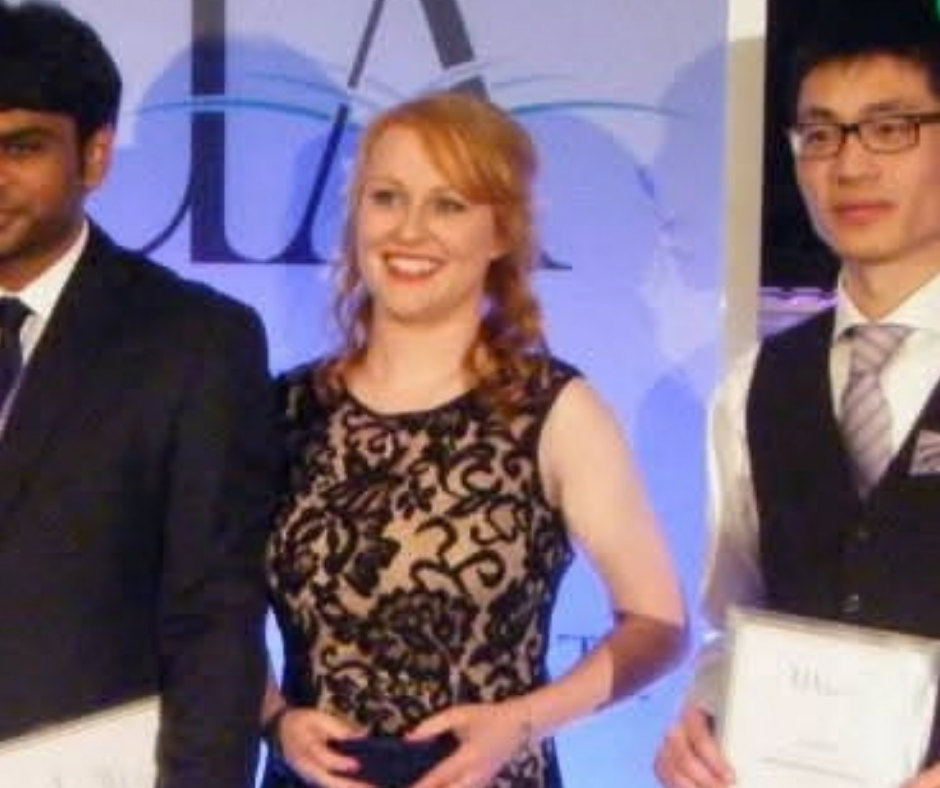
2014 Undergraduate Awards - Overall Winner for Engineering & Mechanical Sciences
October 7, 2026
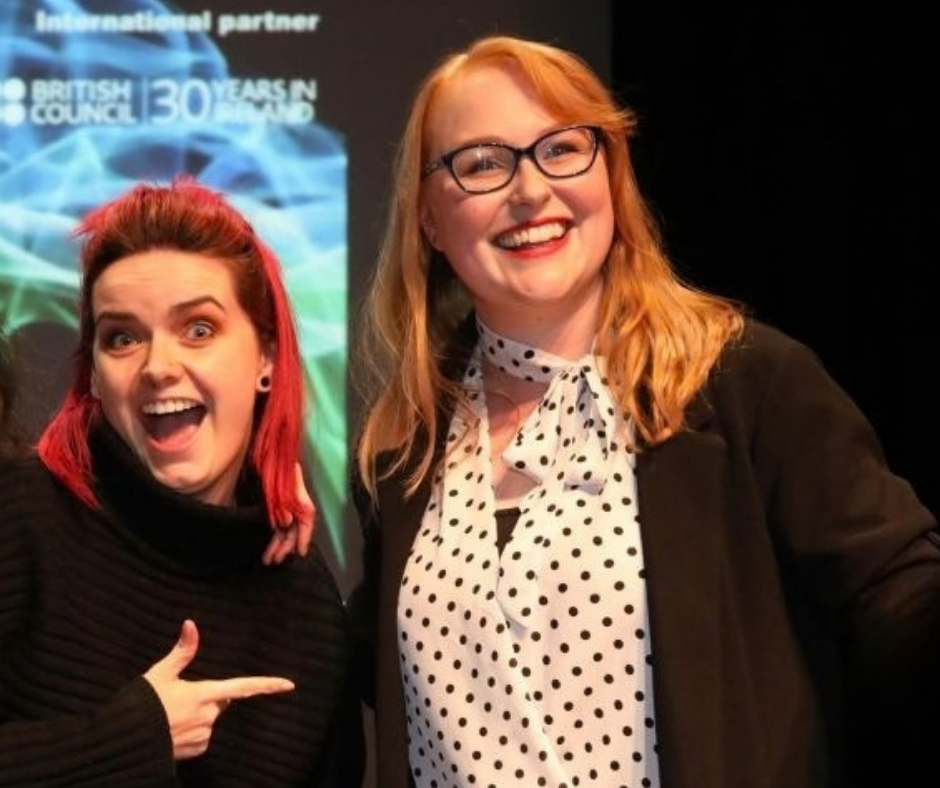
“If you don’t ask, you don’t know. And if you don’t know, you’ll never know. The worst anyone can say is no – and then that’s just data acquisition.”
What happens when a biomedical engineer discovers she’s equally at home on a stage as she is in a lab? You get Dr. Fiona Malone – researcher, science communicator, educator at Atlantic Technological University and one of the Global Undergraduate Awards’ own alumni turned judge.
We recently sat down with Fiona, who was our Overall Winner in 2014 for the Engineering & Mechanical Sciences for a candid conversation about her career journey, the state of women in STEM, the power of human connection, and why she believes the seeds of scientific curiosity need to be planted far earlier than most of us think.
Here’s what she had to say.
If somebody had never met you before, what would you tell them about what you do?
“Oh, God. Even my parents, who would obviously know me, still don’t really know what I do! Fiona laughs.
I’m a biomedical engineer by training. I was always pretty strong in maths, physics, chemistry – that’s what I was encouraged to pursue. But I also consider myself quite creative. I’m really interested in art, I play music, and I always felt I wasn’t sciencey enough for the science and maybe not arty enough for the art.
Somehow I keep ending up back at this intersection. Following the undergraduate awards, I went on to pursue a PhD in biomedical engineering. But I kept gravitating back toward science communication – using performance art, comedy and music as tools to engage with the public and show that there’s a space for all of us in STEM.
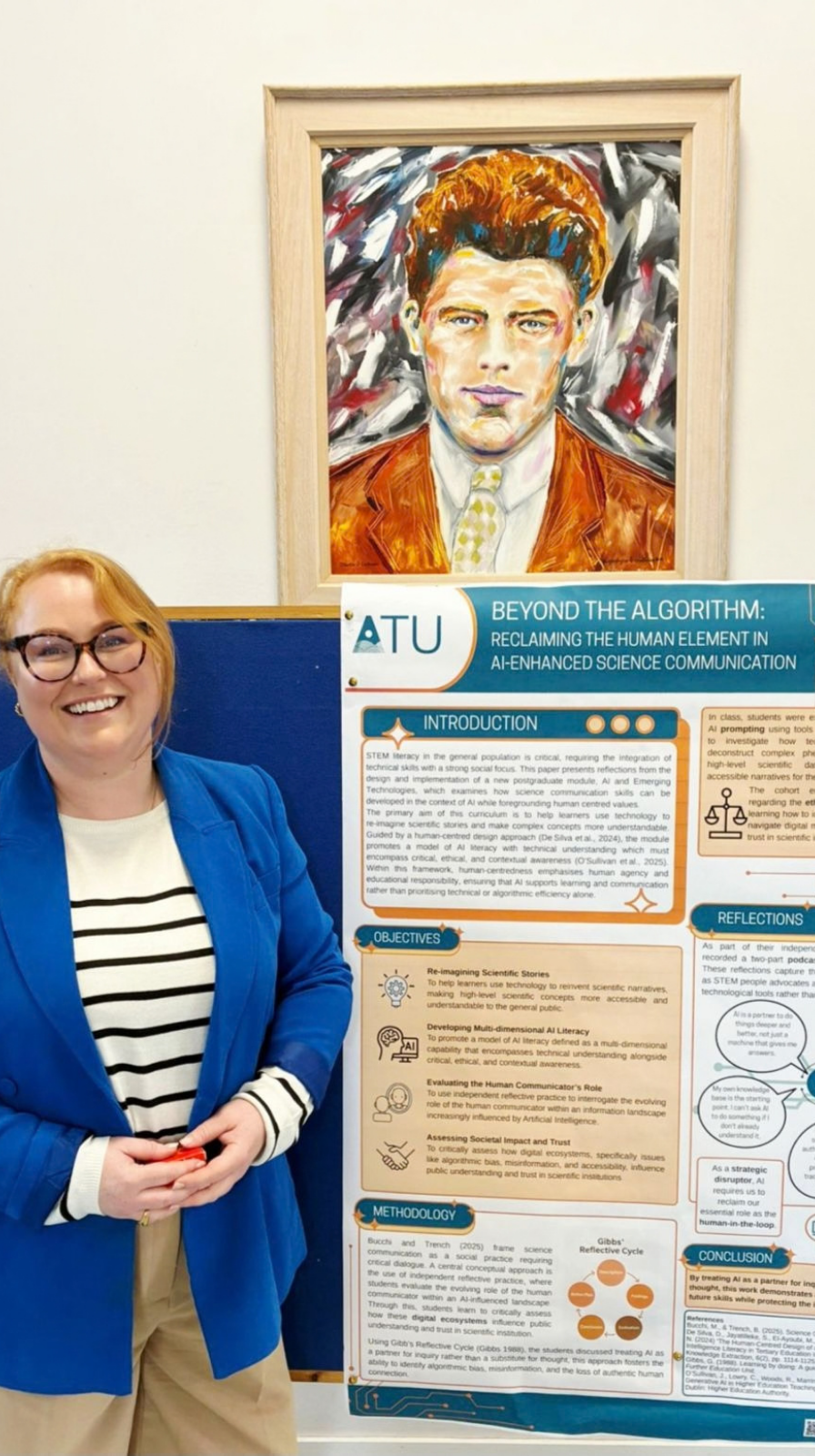
That led us to create a Master’s in Science Communication at Atlantic Technological University (ATU), where I work now. And it’s so fun! I’m getting to have really interesting conversations about things I’m interested in within STEM, but also bringing in creative tools to engage the public.
I think the junction in my career right now is: do I pause the biomedical engineering research and really move into the sphere of misinformation and disinformation in science? We’re at such a difficult time now with people losing confidence in scientific institutions. We’re in generation AI — what can people trust? That’s where I feel I’m supposed to be.“
Do you think there’s a drop-off in people, particularly women, being encouraged to get into science?
“Yes. Based on my own experience and conference data I’ve seen, there’s definitely a drop-off.
I was at an educational conference recently where they looked at mathematical results for students taking their Leaving Cert and moving into mathematical fields. In the mid-to-late 2000s, before a project called Project Maths was introduced in Ireland, girls and boys were achieving H1s in maths at roughly a one-to-one rate. But now? It’s somewhere between three-to-one and five-to-one in favour of boys.
Part of that comes down to subject access. When I was in school, I didn’t have access to things like physics and applied maths at my school. I actually went to the boys’ school to do physics. And I recently went back to that school to talk to the students and it’s still the same way.
If a school is offering applied maths, higher-level maths, and physics together, which typically happens at boys’ schools, then students are taking all three and getting lots of practice in problem solving, creative problem solving and mathematical analysis. Versus a female counterpart who might only choose higher-level maths.
Even beyond that, the number of girls coming to university and picking engineering has dropped as well, which is really disappointing.”
You tell me that women tend to gravitate toward fields like biomedical, chemical and energy engineering over other science options. Why?
“I used to wonder about this myself. I picked biomedical engineering, and there’s often this idea that it’s ‘the girly engineering’, like, you’re a woman, so you care, you know?
A colleague of mine at ATU Sligo does research on equity and equality in engineering education, and she had a really interesting take on it. She said that women tend to gravitate toward fields where they can use their skills for the greater good of the community, solving problems that affect everyone. Healthcare, the climate crisis, pharmaceuticals. Whereas male-dominated fields often emphasise individual achievement, ‘look what I built, this is what I made.’
It’s a very different way of thinking, and I think that really does point to the idea that EQ (emotional intelligence) may be just as important as IQ in shaping these choices. The fields women are drawn to aren’t the ‘softer’ options, but they are the ones tackling humanity’s biggest challenges.”
When you won your Undergraduate Award for your undergraduate paper, were you already on a trajectory toward research?
“It was a combination of things. In my third year, I had received a Women in Engineering scholarship, and I spent 10 to 12 weeks working in a research lab instead of doing a J1 placement like everyone else. Prior to that, I had worked in industry, so I’d assumed I’d do my four years and go back to an engineering company.
But once I got that taste of 10 or 12 weeks in the research lab, I was like ‘oh, maybe I do see myself in a lab. Maybe I am sciencey enough for this.’
My undergraduate research wasn’t isolated work either, I was working alongside a PhD student, doing a side project that fed into his work. There was a real sense of community. That made all the difference to me.
Then I applied for a PhD in Galway. I would have loved to stay in Limerick, where I studied at undergrad, but it can be very competitive. So when the Galway opportunity came up, I thought, ‘let’s go for it.’
I found that transition tough. Moving to a new city, full-time research, trying to make new friends… By October or November, I was starting to think have I made the right call here? A lot of my friends were in industry, making money. Did I make the right call?
…..And then the award came in. And I thought, ‘Okay. Maybe this is where I’m supposed to be.’”
When I won in 2014, I was at a point where I was considering where I wanted my career to take me. The award gave me the confidence to keep going and showed me that there was a place for me in the world of research. Undergraduate work deserves to be recognised, and this year’s winners should be really proud of what they have achieved. My message to these exceptional students is simple: be open to where this experience could take you, because you never know which door it might open.
Dr. Fiona Malone
Do you think your research has changed over the years? What does research look like now compared to when you started?
It’s changed significantly. As an undergraduate, research followed a structured, methodical process. But in my PhD in Galway, it became much more clinically and industrially driven. When you’re working with industry partners, you don’t always get to explore the problem in a global sense. If something works, you go down that track. You have to follow a particular path based on who is funding you.
And I do miss that part of undergrad research where you could ask – okay, why did that happen? Let me focus on this. Pure curiosity-driven inquiry.
Funding priorities have also shifted dramatically. Everything now needs to have AI, sustainability, and climate goals woven into it. Even if you’re developing a new programme to teach people, they want to see AI embedded in it. I understand the practical necessity, but I do feel that research for research’s sake is being lost.
When you’re so focused on results that are driven by money, you might be missing the actual solution. I think that scientists working in a purely results-driven, commercially focused way might miss genuinely innovative breakthroughs.”
If you went back in time, would you have done anything differently? Would you have moved toward science communication sooner?
“I think I was always meant to be an advocate for women and minorities in STEM. If I could change anything, I would have started earlier.
I think advocacy in secondary school is already too late. We need to be fostering curiosity at the primary level, at early childhood, before the negative perceptions of science have a chance to take hold.
I’m actually reaching out to a colleague now who works in early childhood studies at our university. I said, ‘Look, this is what I do. I’d love to develop games or activities,’ and she said, ‘I love that. You combine that with a bit of art, a bit of Play-Doh, a bit of Lego, we’re onto a winner here.’ I’m exploring this further now as I see it as a real chance for a mindset change.
Because that’s where curiosity really lives. My little boy is two in September, he gets so curious about a door handle, or a hinge, or a wheel, or a flower. It’s beautiful. I believe that’s what we need to foster.”
Rapid Fire Questions:
Research is…”Solving problems. You can’t solve a problem without understanding what has come before and where you fit within it.”
Curiosity is…”Excitement. You can be curious about anything it should be fostered from the earliest age possible so it should be exciting”
What does failure teach us?…”Data acquisition. Failure gives you loads of information about yourself and your process. It’s very hard to learn from success.”
One habit that changed everything?…”Networking and communication. I never underestimate the power of small connections, so many of my opportunities came from relationships I almost didn’t bother making.”
One book every undergraduate should read?…Poor by Dr. Katrina O’Sullivan. “Sometimes a hug and a hot meal do more for a student than academic pressure.”
The best advice you ever received?…”‘The work will get done anyway’, from my mum. She told me I was stressing about something that hadn’t happened yet, so I was suffering twice. She was right.”
What should students remember about their Undergad. journey?…”It’s such a short time out of your whole life, even though it feels enormous. Embrace every single second of it.”
What's Next for Fiona...
Fiona is heading into an exciting new chapter – leaning further into science communication research, advocating for early childhood STEM engagement, and continuing to fight for more diverse and inclusive scientific spaces.
We’re thrilled to share that she will be welcoming this year’s Irish winners at the All-Ireland Ceremony October 8th and joining us as a panelist at the Global Undergraduate Awards Summit on 8–11 November at the RDS in Dublin – alongside fellow alumna and judge Dr. Lorraine Chadwick from UCC, one of the programme’s very first winners from 2009. Together, they represent exactly what the Global Undergraduate Awards is about: undergraduate recognition that ripples outward across entire careers.
