
Alumni Spotlight : Robert Finan
In conversation with Robert Finan
November 18, 2026
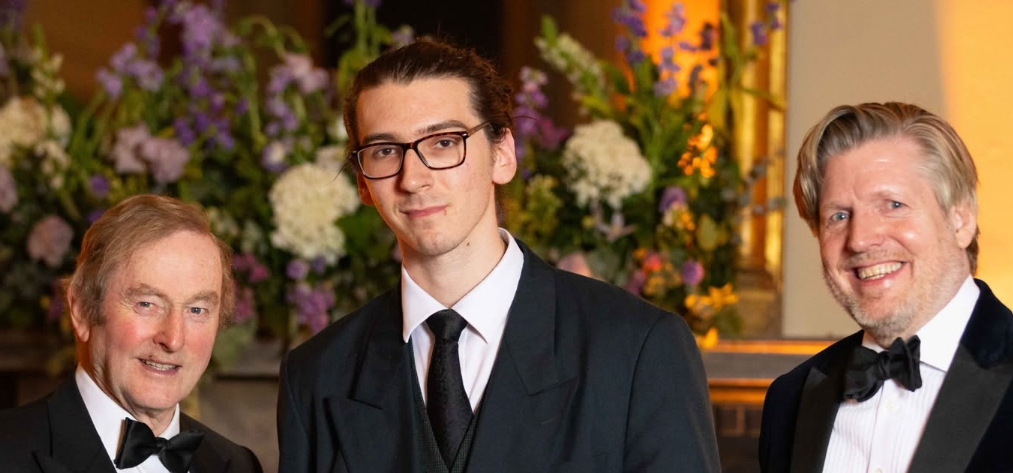
Robert is the 2026 Global Winner for the category of Philosophy and was also acknowledged at a Highly Commended level.
Read his award-winning paper “Against ‘Framelessness’ in Environmental Aesthetics” in our library.
Can you share a bit about your academic journey and how it feels to be recognised as a Global Undergraduate Award winner?
Growing up, I, like many eventual philosophers, was supposed to be a mathematician. Mathematics came naturally to me and excited me, and my time at that age was essentially split between maths and art (drawing, painting, etc.). At about the age of 15, I bought a book (because it was in a closing down sale) called The Story of Philosophy by Will Durant. The book has its failings, but it did enough to introduce me to philosophy and I was immediately hooked. It became clearer and clearer that my interest in maths, in art, and in almost everything was really a subset of my interest in philosophy, though I hadn’t known that beforehand.
I started in Trinity College Dublin with Maths and Philosophy, thinking maths would be the practical and sensible option, while philosophy was what I primarily cared about and found value in practising. Then I realised that the maths I was interested in (and so had any chance of excelling in) was very abstract, and not at all practical, so I switched fully to Single Honours Philosophy. Shortly after that change, I went through a great deal of personal turmoil, including my father’s passing, and my studies suffered for a time. This overlapped with Trinity’s (in)famous Scholars exams, which I didn’t end up successfully completing (partly because I would have had to sit maths exams for them, despite not having been a maths student for many months by then).
I had no funding for my undergraduate degree, so I worked part-time jobs throughout, as well as tutoring privately in maths, philosophy and logic, to make it work. Despite this, my grades climbed steadily from that point on, and I got a first in every assignment in the last two years of my degree. I love my academic work and work very hard at it, and this was the first major reassurance that my efforts may not be in vain, which is, I suppose, what being recognised as a Global Undergraduate Award winner means to me. It also matters practically: I’m entirely dependent on funding for postgraduate study, which is so expensive and is essentially a requirement for anyone hoping to go into academia, as I am. I hope the recognition for my essays will help with this and allow me to pursue the career I want to commit to.
Can you share with us what you have been working on since winning the award?
Since winning the award, my days have been a mix of part-time work, teaching (both independently and with the Modus Ponens Institute), copyediting for MetaScientia, reading, exercising, and applying for funding and postgraduate programmes. I have also spoken at a few conferences (most recently in Potsdam) and am scheduled to speak at LMU Munich, the University of Prishtina in Kosovo, and Maynooth University (as well as the GUA’s summit in November).
More long-term, I have two main projects.
The first is a research project on the philosophy of infinite sets. Broadly, I’m interested in Cantor’s ‘transfinite arithmetic’ and its oddities. Most recently, this led me to write an essay comparing Cantor’s approach with that of C.S. Peirce, whose approach I find very interesting and think can improve our understanding of infinite sets and their relations in mathematics. Eventually, I hope to develop an updated theory of infinite sets that is neither Peircean nor Cantorian (though perhaps I’m slightly more sympathetic to Peirce), but novel and free of the issues I raise in that essay.
My second project is just as time-consuming, and perhaps less niche. I have put together (and am continually updating) a proposal to introduce Philosophy to Ireland’s Leaving Certificate curriculum (our final secondary-school exams). It’s a subject in many other European countries, and mandatory in some. Philosophy has so much to offer, especially in showing students how to think well, how to engage with their other subjects, how to build values, and more. I’ve put together a petition, which I’d be very grateful if you would sign (https://www.change.org/LeavingCertPhilosophy)! I’ve also written a proposal document, built a website with the relevant information, and am running an international survey on the priorities and interests of students, philosophers, teachers, parents and professionals. There is also an open feedback portal to inform the proposed curriculum (all links at https://philosophyforleavingcertificate.com/). This initiative is extremely important to me and I’d appreciate all the help I can get! I hope to formally submit the proposal in the coming months, and hope it can lead to Philosophy’s inclusion in the Leaving Certificate curriculum in the coming years!

What advice would you give to aspiring students who are considering submitting their work to the Global Undergraduate Awards?
There is absolutely no reason not to submit. I was reluctant to submit because I was sure my essays weren’t good enough, but eventually I convinced myself I had nothing to lose (and that it was easy enough to do). The submission I thought was best got Highly Commended, and the essay I thought had absolutely no chance won globally! I suppose it goes to show that you can never say for sure how your work will be received, and by submitting you have everything to gain and nothing to lose!
Reflecting on your time in academia, what were some of the most significant challenges you faced, and how did they contribute to your personal and academic growth?
Most of the challenges I faced were personal to me and my family, and they affected my academic journey insofar as they affected every part of my life. I won’t go into depth here, but extended periods of close personal bereavement, and the practical difficulties that came alongside them, made keeping up my academic commitments harder than I would have hoped. Being able to work through times like that, and consistently looking back at where I was a year ago and recognising that I’ve improved, is one of the most reassuring experiences I’ve had (and I certainly needed it).
Beyond your individual success, how do you envision your academic achievements contributing to your community or the broader world?
I suppose ‘academic achievements’ is quite broad. I’d consider my teaching (of both mathematics and philosophy) and my public engagement (like the proposal to introduce philosophy to the Leaving Certificate) to be, in a sense, ‘academic achievements’. They’re among the achievements I’m most proud of, exactly because they have such a clear impact on the broader world. All of this is essentially about teaching, which I think is one of the most important and impactful things someone can do, and I would love to do it on a larger scale one day. The impact teaching can have on someone is exceptional on a personal level. Further, I think good educators and mentors are a prerequisite for positive social change: for there to be substantial change, people need to want it, and people only come to want it through proper education, well thought out values, and clear information.
Beyond teaching, I think my more purely ‘academic’ endeavours have some broader impact too. Philosophy has a reputation for uselessness, and for pompous academics sitting with their heads in the clouds. I think that’s an unfortunate misconception, because there is nothing elitist about philosophy. It can be done without anything (no lab, no equipment, etc.). I think its value shows in two main ways. First, there is inherent value in the questions themselves: it matters to understand the nature of beauty, minds, numbers, reasons, morals, evidence, and so on, and that is meaningful in and of itself. Second, and more practically, improvements in our lives always start as an idea, and the core of those ideas often starts in philosophy. On a large scale, entire fields like psychology have their roots in the philosophy of mind; on a more technical scale, some developments in computation, formal linguistics, topology, etc. have their roots in logic, the philosophy of language, and the philosophy of mathematics respectively. My own work, I hope, might have some small impact on mathematics and, through it, on related fields (e.g. computer science and physics).
Many students have diverse interests. How have you managed to integrate your academic pursuits with your other passions or interests?
This question feels very well suited to philosophy students! Very briefly: I have always loved art, especially painting, and philosophy lets me explore and enrich that through aesthetics. I have always been interested in and studied maths, and the philosophy of mathematics lets me enrich that further and understand mathematics better. The same can be said for most of my interests: psychology, law, computer science, literature, music, and perhaps most notably the impact moral philosophy has had on my relationships with other people, and my role in the world.
Can you share the role mentors or advisors played in your academic journey? Any specific advice that profoundly influenced you?
I have been exceptionally lucky with teachers and mentors throughout my life, and that has shaped both my approach to teaching and my passion for learning. I’m reluctant to single out specific teachers, as I couldn’t mention all the excellent people who have helped me throughout my life without filling a book. In primary school, secondary school and university, I have been privileged to have excellent and supportive teachers, lecturers and mentors. There are a few instances I’m specifically grateful for. In fifth class in primary school, my teacher let me and a friend do maths on the computer at the back of the class on Khan Academy while the other students went over the homework, and those lessons gave me some of the most important foundations of my education. In secondary school, my Leaving Cert English teacher introduced me to literature in a way that made me believe one could do important and worthwhile work beyond the STEM subjects. And in university, I was lucky to receive excellent support, advice and guidance on my work beyond anything anyone could have expected of a lecturer.
As for specific advice, two pieces stick with me, one from my uncle and the other from my father. The first was to follow my interests. I’ve found that if you choose, say, your school subjects based on what interests you and let those interests develop naturally, they will almost certainly support your later interests in some way. Then you can choose your university course based on your interests, with a foundation already in place, and so on and so forth. The fact that the ideal direction will change later doesn’t make the direction you’re currently heading any less right. The second was “if you see something that needs doing, then do it”, which needs no further explanation.

Looking ahead, what are your aspirations and goals, both academically and personally, and how do you plan to continue making a positive impact?
As I mentioned, my main short-term goals are to get a funded master’s degree in philosophy so I can pursue my research in the philosophy of mathematics, and to get philosophy added to the Leaving Cert curriculum. In the long term, I want to be in a position where I can sustain myself, teach, and contribute to philosophical research and public engagement with the subject. Right now, the main route to that would be becoming a professor, preferably at an Irish institution. If all goes well, perhaps other options will open up too, such as becoming a secondary school teacher (in the event that philosophy joins the Leaving Cert). I want to teach philosophy and pass on what has been given to me to as many people as possible, through teaching and writing. Whatever form that may take remains to be seen.
Is there anything else you’d like to share with our listeners – perhaps a piece of wisdom or a lesson you’ve learned during your academic journey?
If there’s a lesson I’d pass on from my own journey, it’s to allow yourself to look back at where you were a year ago and recognise the improvement. I’d also like to reiterate that philosophy is so important. Thinking well, and properly assessing your own values, is exceptionally important, and the more we can bring that into the education system, the better. I worry about the state of education, and this is one path to real improvement. I’d really encourage people to sign the petition, take the survey, give feedback on the proposed curriculum outline, and share the proposal with friends and family. The Leaving Cert is being redeveloped, which gives us a great opportunity to add this diverse, impactful and valuable subject to the curriculum (https://philosophyforleavingcertificate.com/).
