
GUA Alumni: Dr Lorraine Chadwick
Dr. Lorraine Chadwick's medal from the inaugural Undergraduate Awards still sits on her mantelpiece at home - a daily reminder that it's never too late to pursue your dreams, that failure is not final, and that sometimes all it takes is one person believing in you to change the trajectory of your entire life.
August 25, 2026
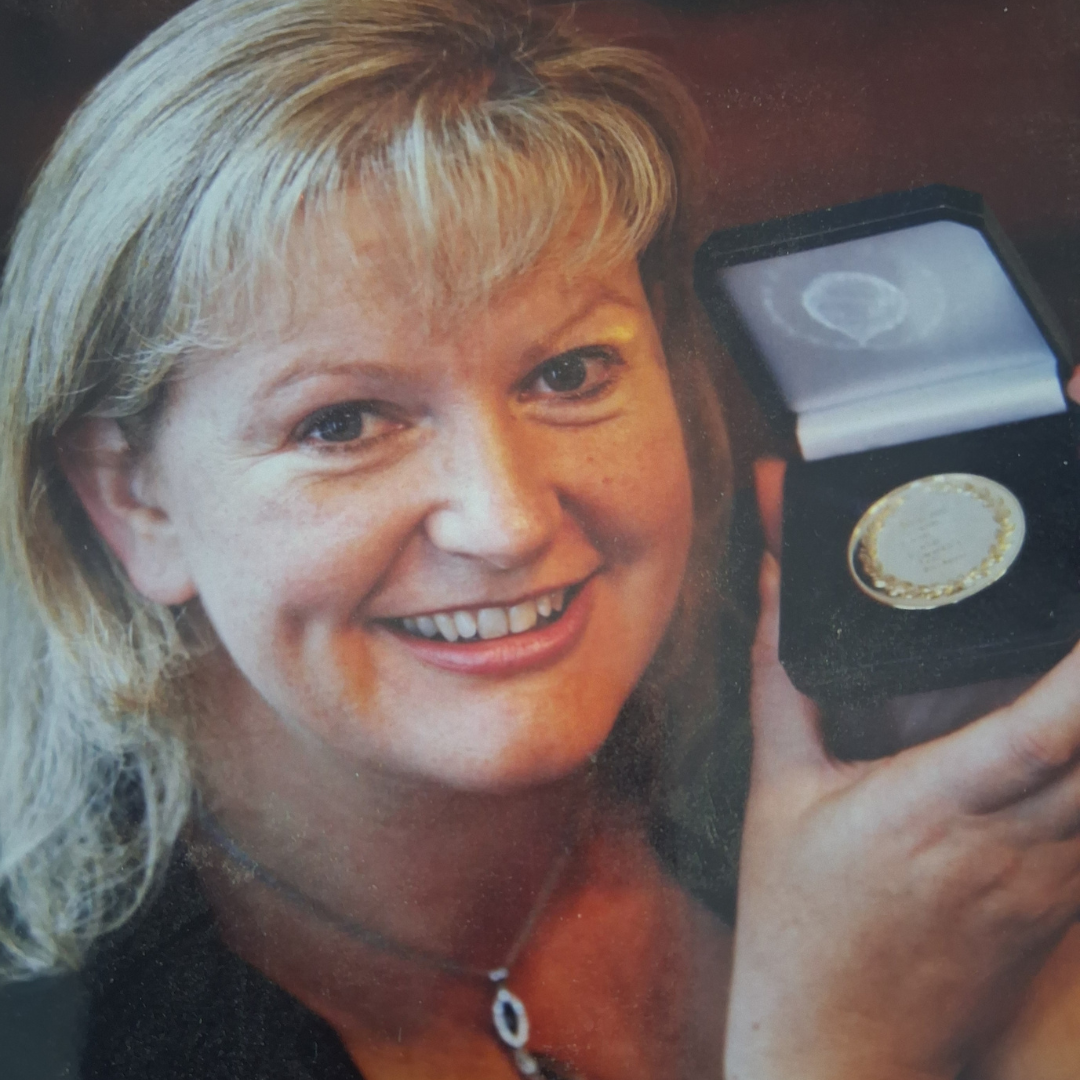
Now a full-time academic at University College Cork’s School of Education, Lorraine’s path to academia was anything but conventional. As one of the inaugural winners of the Undergraduate Awards in 2009, Lorraine’s story is one of resilience, second chances, and the transformative power of recognition. In this conversation, she shares her remarkable journey from a failed first attempt at university in the 1980s, to becoming a mature student juggling work and family, to ultimately earning her PhD and now serving as a judge for the very awards that changed her life.
The Early Years: A False Start
Diane: Lorraine, let’s go right back to the beginning. When you finished your Leaving Certificate, did you go straight to college?
Lorraine: I did, yes. I went to University College Cork in 1986 when I was just 17. I was studying maths, statistics, computers and economics as part of a broad arts degree. But honestly, I was a young and immature teenager. I’d come from a convent school, and suddenly I had all this freedom. I met the most fabulous group of friends, had way too much fun, and… well, I failed all but one of my exams.
Diane: What happened after that?
Lorraine: I took myself to America on a J-1 visa and when I eventually returned to Ireland, I went to Secretarial College, started working for an insurance company, had children and settled down. I resigned myself to thinking college just didn’t work out for me, I simply wasn’t ready.
The Turning Point: A Father’s Legacy
Diane: So what brought you back to education nearly two decades later?
Lorraine: My father died unexpectedly in 2003. He was only in his 50s. About three weeks after his death, I was sitting at home one evening and I just thought, “Oh my God, I’ve really let him down.” You see, he had been funding my college education back in the 1980s, and Diane, at that time the fees were so expensive, and interest rates were really high. For that month after he died, I was wracked with guilt that I hadn’t fulfilled my potential, that I hadn’t just copped myself on.
Diane: That’s a powerful motivator.
Lorraine: It was. I decided then and there, I’m going back to college. I’m going to do economics, because that was the one subject I’d really liked. So I went online and discovered that UCC was offering a BA by night. I could pick my subjects, so I chose economics, geography and history. And how lucky was I? It turned out that 2004 was the very last cycle of that night degree programme they ever ran. It was as if somebody was looking down saying, “You have to do this.”
Discovering Her Potential
Diane: How did it go… returning as a ‘mature student’?
Lorraine: In my second year, I received my first college scholar award, I finished top of the class for the diploma. The same thing happened for the degree. I was top of the class again. That’s when I realised, “Oh, I’m actually capable of doing this.” It wasn’t that I couldn’t do it before; I just wasn’t ready at 17. After that, I went on to complete my teaching qualifications, then a postgrad in educational leadership, then a masters and eventually a PhD all while working full-time and raising my children.
Diane: That’s extraordinary. And all of this was happening while you were working full-time?
Lorraine: Yes, everything. I was working for the same insurance company for about two decades, going to college by night, and looking after my family. It was intense, but I was determined.
The Undergraduate Awards: A Life-Changing Moment
Diane: How did the Undergraduate Awards come into the picture?
Lorraine: It was one of my Economics lecturers, Daniel Blackshields, who had mentioned it. He said, “Lorraine, you’ve submitted an essay that’s really good. I think you should send it in to this new competition, it’s the inaugural year.” I remember looking at him thinking, “Are you mad? I’m not at that standard!” But I decided to give it a go. I submitted an economics paper motivated by the fact that three members of my family were waiting on kidney transplants at the time.
And, unbelievably, I won! I shared the economics award with another another Economics student, Michael Curran. I was absolutely shocked.
Diane: I understand you had some concerns about winning?
Lorraine: [laughs] Oh yes! At that time, I was teaching religion at a Catholic secondary school in Cork and I’d written this paper advocating for the economics of advocating for a discussion surrounding a regulated market for kidneys – touching on all these ethical and moral questions. I had this recurring dream in the weeks before the ceremony that someone was going to say, “You wrote this paper, you’re teaching religion, and now you’re going to lose your job!” I didn’t sleep properly for weeks.
Diane: That must have been terrifying.
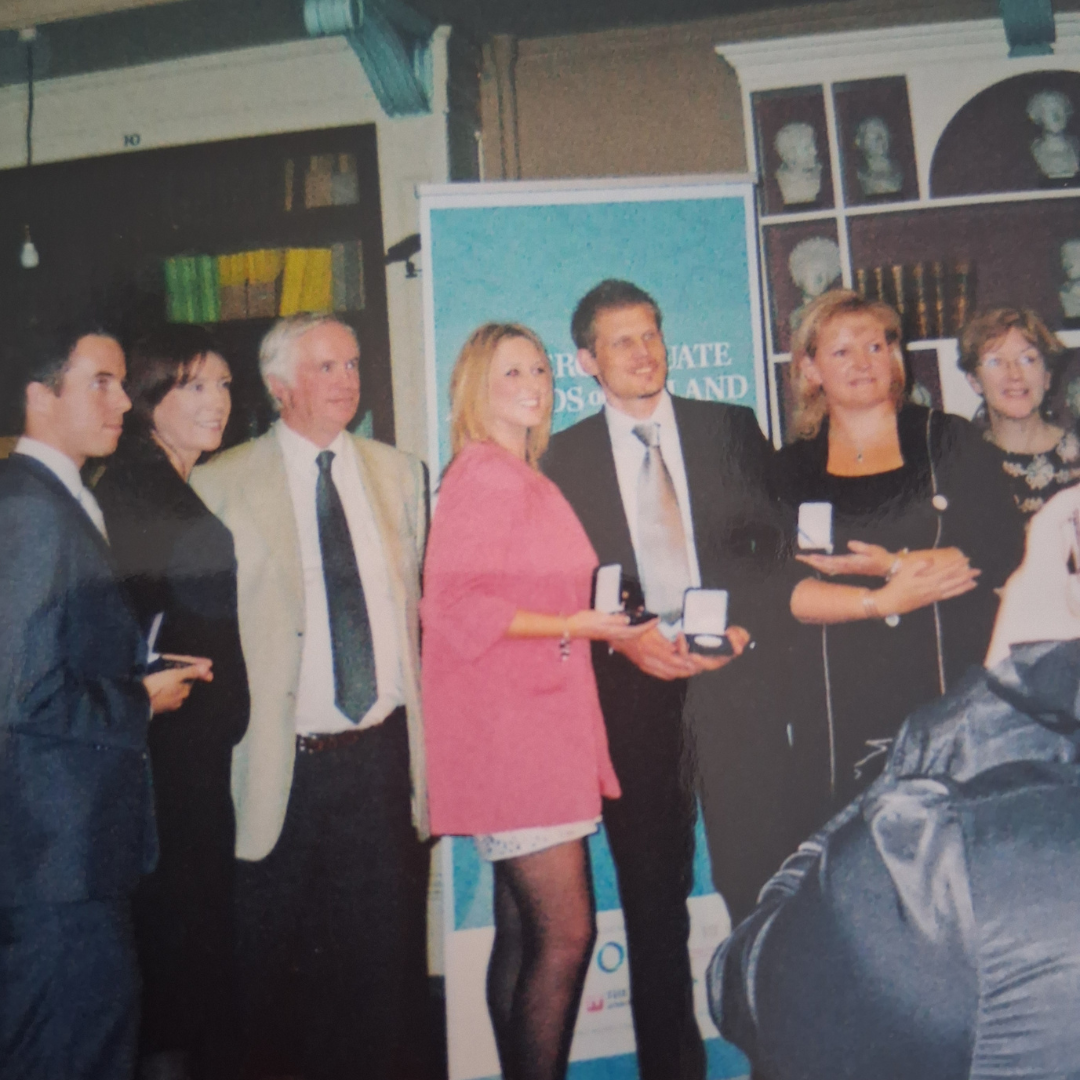
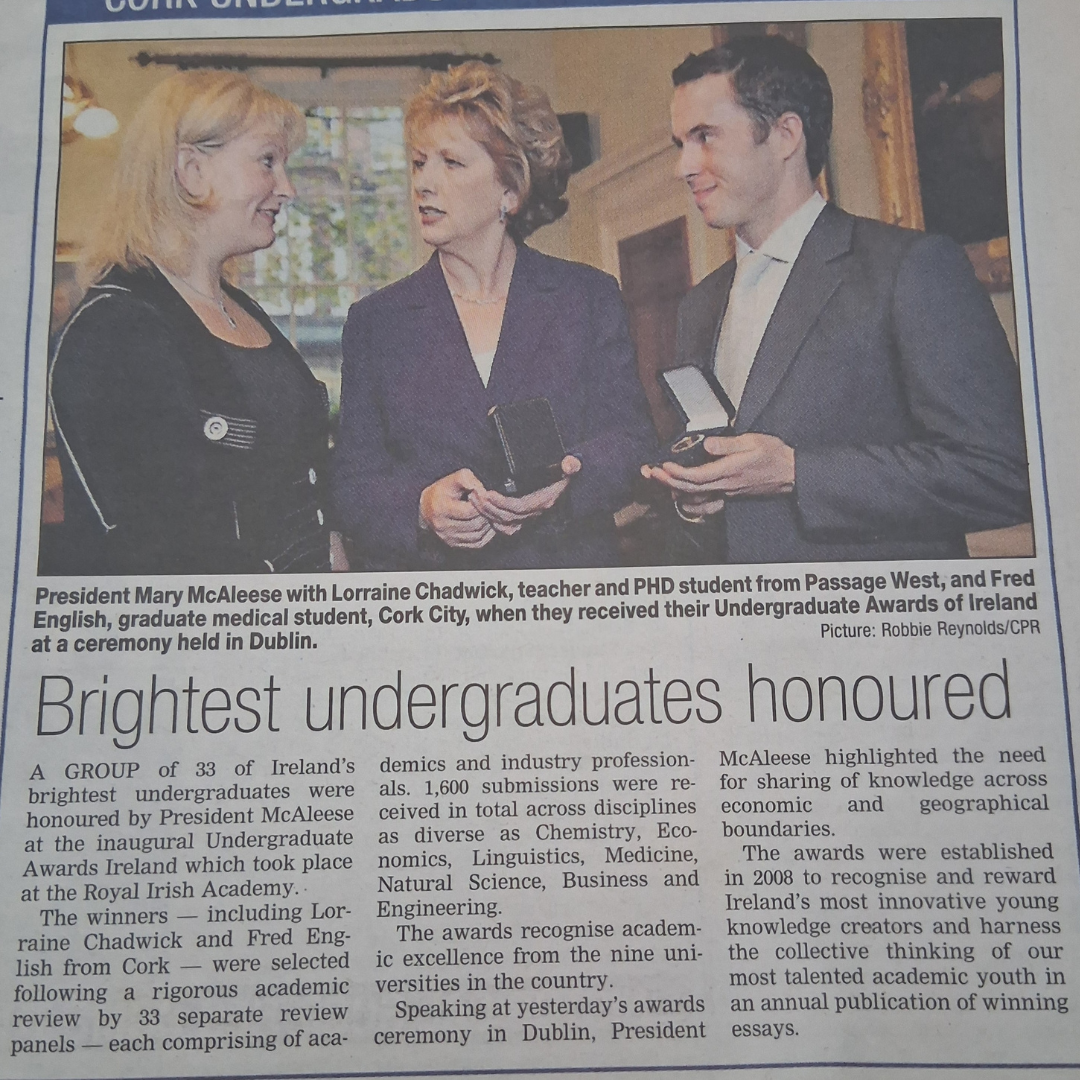
Lorraine: It was! On the day of the awards at the Royal Irish Academy, this man approached myself and another winner from UCC for Medicine, Fred English, and said, “Excuse me, could we borrow you for a minute?” I thought, “Oh my God, my dream is coming true!” But it turned out we’d been asked to meet with President Mary McAleese for a photograph and a chat. What a privilege! What an honour! After that, I calmed down considerably. [laughs]
Meeting President McAleese
Diane: What was it like meeting President McAleese?
Lorraine: It was wonderful. My mother was there and she was so proud. President McAleese’s speech really stayed with me. She talked about how the awards encourage top undergraduates to believe in the validity of their work and in their entitlement to a place of respect within scholarly discourse. At the time I thought it was a bit lofty, but actually, it did help me believe in myself.
Diane: It sounds like that recognition was transformative.
Lorraine: It absolutely was. For the previous 20 years, the only thing I’d ever written was a cheque I’d looked after my children, gone to work, and that was it. Winning at a national level was the first time I truly believed I could write and that maybe there was more to me than being a wife and a mum.
The Spark of Self-Belief
Diane: Did winning the award cement the confidence you needed to continue, or was that confidence already there waiting to be found?
Lorraine: I think it was the spark that helped me believe in myself. Graduating top of my class was meaningful, but winning at a national level was transformative. It was the first time I truly believed in myself and my ability to write and contribute academically. Before that, I hadn’t written anything of academic significance in nearly 20 years.
Falling in Love with Research
Diane: Once you got going, did you enjoy the research process?
Lorraine: Oh, research is the most fun! You get to meet the most amazing people. At the moment, my work spans several areas. I’m collaborating with colleagues in the School of Education at UCC on research exploring AI in education, alongside my own research on student voice at post-primary level and work connected to Senior Cycle redevelopment.
From October, I’ll also be involved in a European COST (European Cooperation in Science and Technology) Action titled Participation, Well-being & Resilience of Children in the Era of Polycrisis. This work will bring together colleagues from across Europe to explore how children’s participation, well-being and resilience can be supported in the context of challenges such as conflict, famine, the influence of technology and wider global uncertainty. Being part of these conversations and having the opportunity to contribute my own perspective and experience, is something I’m really looking forward to.
Diane: You teach full-time now at UCC, don’t you?
Lorraine: Yes, I’m in the School of Education, teaching new teachers, as well as working on research with colleagues both at UCC and across Europe. It really is the best job in the world.
You Stayed at UCC?
Diane: You completed all your qualifications at UCC. What kept you there?
Lorraine: Geography and family, really. When you have children, they’re rooted in a particular place. My husband’s job was in Cork, his career was there. I knew that if I wanted to keep going academically, I wasn’t going to be able to take advantage of opportunities like Fulbright scholarships elsewhere. But you know what? That was okay. UCC is the most phenomenal university. They supported me through every stage, the degree by night, postgraduate work and completing my PhD during COVID. The collegiality, the cooperation, the respect, it’s like family. I feel incredibly lucky.
Coming Full Circle: Becoming a Judge
Diane: Now you’re a judge for the Undergraduate Awards. How does that feel?
Lorraine: I’d been thinking about how to give back, especially to women in academia. When the opportunity to judge came up, I thought, “Oh my gosh, this is perfect! I’ve come full circle.” If I can be here for many years to come, that would be phenomenal. It’s such an important space.
Diane: How do you find the judging process?
Lorraine: It’s straightforward and well-scaffolded by the awards team. I judge in the Education category, and the quality of submissions is excellent. What I love most is the originality, the ideas. Whether it’s papers on early childhood education, AI in third-level settings, or sustainability-focused classroom interventions, it’s all really wonderful to read, and there are some brilliant minds out there.
Universal Truths in Education
Diane: Reading papers from around the world, do you find that student consciousness differs globally?
Lorraine: Topics vary by country, of course, but the human element consistently shines through in all submissions. That’s the wonderful thing about education. Students across the globe, whether from Singapore, the UK, or elsewhere, tend to focus on local-level problems, particularly the child or student in front of them, in Education anyway. But common themes prevail, like sustainability, technology and relationship-based teaching. What’s fascinating is that locally focused research is often globally transferable, because children’s fundamental needs are universal.
Lessons for the Classroom
Diane: Will you take anything from the judging experience back to your own teaching?
Lorraine: Absolutely. It’s reinforced for me the importance of emphasising to my students that teaching is fundamentally about relationships, and that local observations and interventions can have global relevance. If you solve a problem you’ve observed in your own space, nine times out of ten that’s transferable across the globe, because children are children. They need to be nurtured, supported and encouraged, whether they’re 4 or 14, in fact any age.
Recognising Potential in Others
Diane: Can you spot that spark of curiosity and potential in your own students now, the way Daniel Blackshields once spotted it in you?
Lorraine: Yes, I can. Most of my students are postgraduates completing their Professional Master of Education, and one of the things I value most is seeing how students develop over time. Growth can happen at any stage, and students often find their confidence, curiosity or academic voice in different ways and at different points in the programme. That spark of curiosity can emerge at any time, sometimes when a particular topic, question or conversation resonates and opens up a new way of thinking. I try to create the conditions for that growth through dialogic lectures built around discussion, questioning and genuine interaction. Rather than remaining at the top of the room, I move among the students and encourage dialogue, even in very large groups. For me, it’s about modelling how my student teachers should enact their practice; creating a space where everyone has the opportunity to contribute, question, develop their thinking and recognise their own potential.
The Most Important Role
Diane: Of all the versions of you, economist, teacher, deputy head, researcher, parent, which one taught you the most about where you are today?
Lorraine: The mother. Without hesitation. Mothers have to be economists, pediatricians, accountants, psychologists. We have to be super-organised. I have two incredible daughters and they’re amazing young women. I’ve just become a grandmother; my grandson is nine months old. When I go to work, I’m Dr. Chadwick, but fundamentally, being a mum has taught me the most.
It’s taught me about patience, organisation and waiting for things to happen. That’s an important message for undergraduates, too.
An academic journey is not linear. There will be ups and downs, things you don’t expect. You have to be patient with yourself, allow yourself time to grow, space to think, time to read. We live in a world of instant gratification, but that’s not feasible if you’re really going to think deeply about the world around you.
Rapid Fire: Wisdom in Short Form
Diane: Let’s do some quick-fire questions. Research is…
Lorraine: Fun!
Diane: Curiosity is…
Lorraine: Hard work. It involves deep thinking, going around in circles, sometimes down rabbit holes.
Diane: Failure has taught you…
Lorraine: Everything I needed to know about myself. I’ve failed so many times, and I’m so proud of it. When I went back to college in 2004, I tried to get rid of my original UCC student number because I thought it was unlucky. They wouldn’t let me! So now, when I look at my transcripts with my PhD, my master’s, all those first-class results, that front page with my old, failed number always reminds me that it is perfectly fine to fail.
Diane: One habit that changed your career?
Lorraine: Perseverance
Diane: One book every undergraduate should read?
Lorraine: When Breath Becomes Air by Paul Kalanithi. It’s a memoir by a neurosurgeon who was diagnosed with a brain tumour. His story is about reflecting on what gives life meaning when time becomes limited.
Diane: One misconception about research?
Lorraine: That it’s lonely. People think you’re locked in your ivory tower doing everything on your own, but that’s not how it is at all. You’re building on the work of others and working, much of the time, in spaces that are collegial and supportive. I believe that research shouldn’t be done in isolation!
Diane: The best advice you ever received?
Lorraine: “Keep going.” From my dad.
Diane: Final thought: I hope students remember that…
Lorraine: It is okay to fail. But you must pick yourself up, dust yourself down, take a deep breath, and keep going.
