
Things You Should Know: is the most radical act of protest simply slowing down?
In an era of hyper-efficiency and automated creation, is ""slow art" necessary to resist rapid digital acceleration.
July 29, 2026
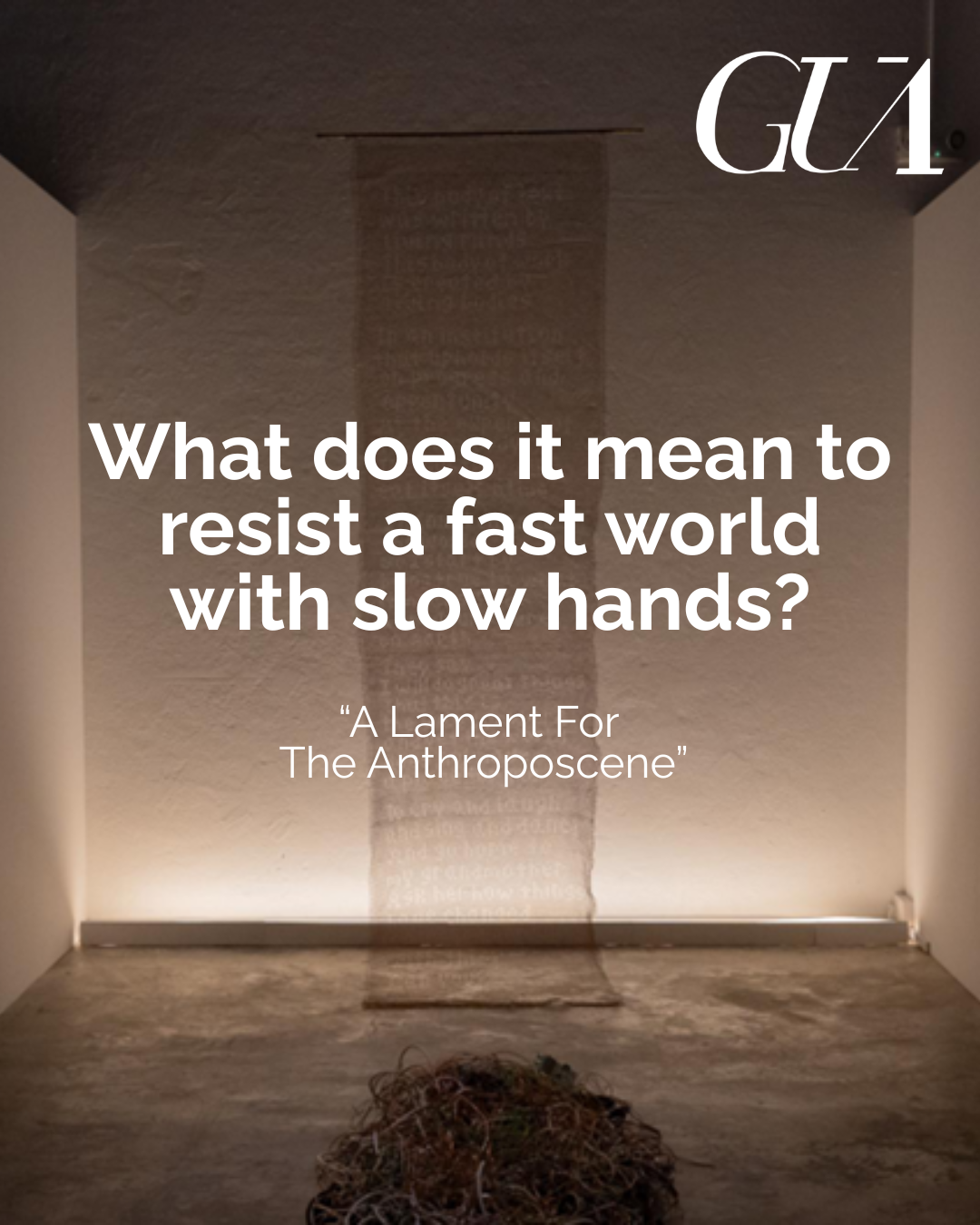
Nicky Josephine Tjandra and Brigette Teo from Nanyang Technological University explore this tension in their project, “Lament for the Anthropocene.” Their research investigates the profound cultural and environmental shifts of our current geological age—one defined by human impact—positioning the preservation of “slow art” as a necessary counterpoint to rapid digital acceleration
The core of their work is a handcrafted, knitted manifesto created from recycled electronic waste. By stripping wire “blood vessels” from discarded printers, televisions, and smartphones, the authors reclaim the materials of the digital age to rebuild a physical record of lived experience.
This 245-hour labor of love serves as a deliberate act of resistance against an economic ecosystem that often values efficiency and speed over human creativity.
Tjandra and Teo’s work is particularly resonant in the context of modern institutional priorities. Their research highlights a systemic tension: while digital innovation promises progress, it often marginalizes the arts, reduces physical creative spaces, and leaves gig-economy designers vulnerable to displacement by generative AI.
Furthermore, the authors address the staggering environmental cost of this progress, noting that global electronic waste is rising five times faster than documented recycling efforts.
The installation draws a fascinating intellectual parallel between modern programming and traditional fibre arts. Tjandra and Teo argue that textiles were humanity’s earliest form of automation, noting that the binary logic of 0s and 1s finds its ancestor in the interlocking stitches of the loom.
By using the “filet crochet” technique—a process that currently cannot be replicated by machines—the authors subvert the expectation of kinetic or reactive digital interaction, offering instead a zero-energy work that demands patience and human touch.
Ultimately, “Lament for the Anthropocene” is more than a critique of technology; it is an inquiry into what ways of “being and making” are lost in the rush toward progress. By restoring the visibility of “slow” labor, Tjandra and Teo provide a framework to rethink the unseen systems shaping modern life
🔗 Want to learn more? Read the full paper free in our Library: https://gua.soutron.net/Portal/Default/en-GB/RecordView/Index/3467
The Library is the Global Undergraduate Awards’ free collection of globally recognised research from past winners. In our new series, Things You Should Know, we are spotlighting that work one paper at a time.
